
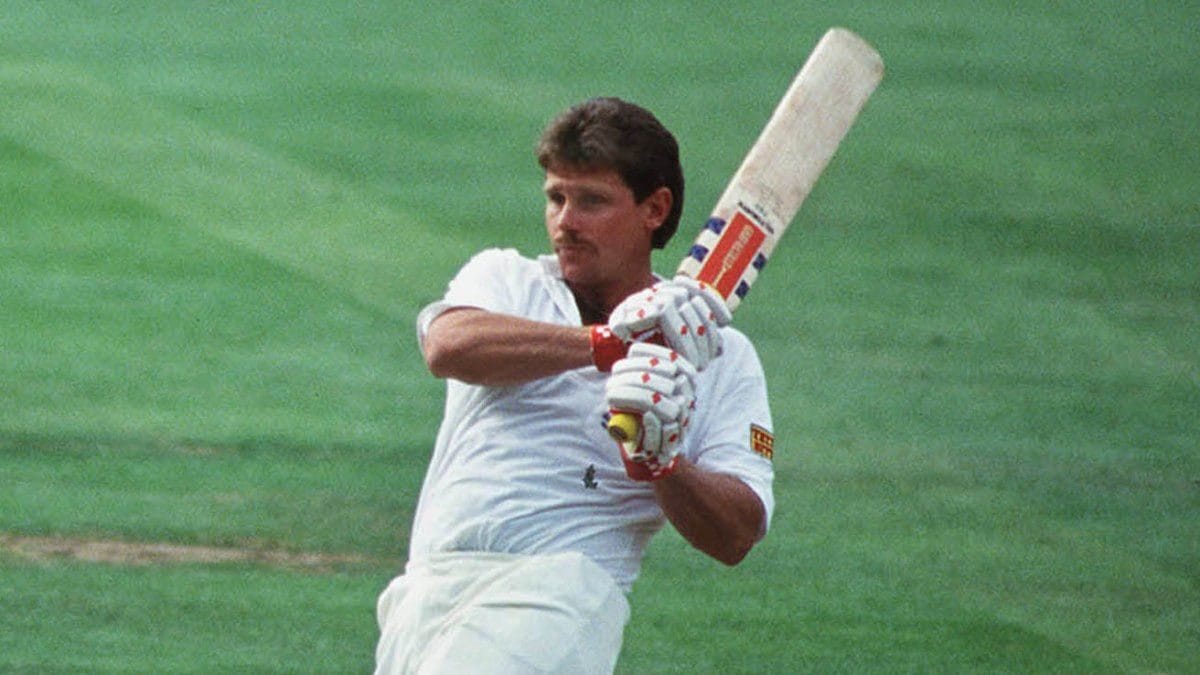
Other England batsmen have been more prolific, more stylish, more reliable, or more dependable in all conditions. But few, in any era, can have been more genuinely popular, with teammates and supporters, than Robin Smith whose untimely death in Perth at the age of 62 was announced on Tuesday 2 December.
He was not as popular, sadly, with the England management and selectors of the day, critically just before the appearance of central contracts. Despite his magnificent record against what was arguably the greatest Test side of all time, the West Indies of the late 80s and early 90s, Smith was far from being a regular against other opponents. In a Test career which lasted from 1988 to 1996, he played 62 matches and averaged 43.67, hitting nine centuries and 28 other scores of over fifty. Of the England batsmen who played alongside him in Test cricket, only two, Graham Thorpe (44.66) and David Gower (44. 25) had higher averages. (Zak Crawley has played 62 Tests and averages 31.77, with five centuries and 21 fifties; Ollie Pope has played in 64 Tests and averages 34.55, with nine centuries and 16 fifties.) One explanation for Smith’s omissions from England sides and squads was a perceived weakness against spin, apparently revealed in some trying encounters with Shane Warne in the latter’s first Ashes series, in England in 1993. The Judge may have been one of the first but was certainly not the last, batter to be baffled by the magnificent leg-spinner – subsequently a great friend. The winter before, though, on the challenging tour of India and Sri Lanka, he topped the first-class averages, and scored a hundred as an opener in the first innings of the only Test against Sri Lanka at the Sinhalese Sports Club in Colombo, an innings in which the great Muttiah Muralitharan – admittedly near the start of his career – bowled 48 overs. That was Smith’s eighth Test hundred, the only one he scored as an opener and the first one he scored overseas. At that point his Test average was 49 and his average against West Indies 50.
It is Smith’s performances against West Indies that people will remember. 5’8’’ tall, and stocky, with very strong forearms and shoulders, his unmistakable trademark was a punishing, almost savage square cut. Gower has said that he moved from Leicestershire to Hampshire partly to avoid having to field to Smith’s square cut. The other indelible memory is his response to the inevitable barrage of short balls. Sometimes he took them on; that was spectacular enough, as he was a brilliant hooker and puller. But it was, if anything even more memorable when he went into evasive action, often ducking and weaving with both feet off the ground, the personification of energy, courage and skill.
Smith came into the England side in the fourth Test, at Manchester, of the West Indies series of 1988. Chris Cowdrey was captain – England’s third of the series (he was dropped for the next game) – and England duly lost. But one of England’s brightest spots of this woeful series was the fourth wicket stand between Smith and his fellow South African Allan Lamb; Smith made 56.
The 1989 Ashes was if anything even worse for England with the home side losing a six match series four-nil to what was expected to be an underwhelming Australian side, but it saw the real emergence of Smith as a Test cricketer. He easily topped England’s batting averages, with 553 runs at 61 in five Tests (this was the series in which England used 29 players) and he scored 143 (out of 260) in the first innings of the fourth Test at Old Trafford, and 101 in the first innings of the fifth Test at Trent Bridge. He had made 96 in the second innings at Lord’s. A feature of the series was the duel between him and fast bowler Merv Hughes. He was selected as one of Wisden’s Five Cricketers of The Year.
He performed consistently in a typically challenging series in the Caribbean in 1989-90, which the hosts won two-one, scoring 186 runs in seven innings. He revealed a new degree of patience against the faster bowlers, spending fifteen hours at the crease altogether. He was as courageous as ever, being required reluctantly, as Wisden put it, to retire hurt as England fought to avoid defeat in the fifth Test at St John’s. He scored 57 in England’s victory in the second Test at Kingston, England’s first win against West Indies for sixteen years and thirty Tests.
He enjoyed the run fest in England in 1990, scoring two centuries against India. He struggled in Australia in 1990-91, but the summer of 1991 saw The Judge at his absolute best. England held West Indies to a two-all draw, the side emboldened and inspired by Graham Gooch’s magnificent match-winning century in the first Test at Headingley. In the second, at Lord’s, England were 84 for five, in response to West Indies’ 411, when Smith was joined by Jack Russell. They added 96 and Derek Pringle also batted effectively, England finished on 354, with Smith making 148 not out in almost seven hours of what Wisden called “graphic concentration”; the match was drawn. Smith scored another century in the final Test at The Oval, and headed the averages, scoring 416 runs at 81.20 in four Tests.
There was a century in the first, drawn, Test against Pakistan at Edgbaston in 1992. That turned out to be Smith’s last Test century at home. He was also an accomplished one -day player, featuring in England’s World Cup squads in Australasia in 1992 and the subcontinent in 1996. His greatest achievement in ODIs was undoubtedly his 167 not out against Australia at Edgbaston in 1993, scoring 76 from his last 30 balls (England totalled 277 for five and lost by six wickets; Warne wasn’t playing.) Smith’s score was the highest by an England player in ODIs until overtaken by Alex Hales in 2016.
It was around this time that his place in the Test team began to come under scrutiny. His struggles against Warne early on in the Test series meant his place was in doubt but he scored 191 for Hampshire against the tourists just before the third Test (again Warne wasn’t playing) and he played some solid knocks in the remaining games. There followed a tour of the Caribbean and this turned out to be a bitter disappointment. Alan Lee, in Wisden,said he was” probably the greatest single failure of the party.” This was partly because so much was expected of him, but he also got into technical difficulties, and made four scores of twelve or under in the first three Tests. (Tour manager Keith Fletcher suggested he was distracted by commercial opportunities.) In the fourth, at St John’s, when Brian Lara made 375, Smith scored 175. It was his highest Test score and his last Test century.
Ray Illingworth was appointed chairman of selectors during that tour and this appointment does not seem to have done Smith any favours. He was dropped for the series against South Africa in 1994, in which he was desperately keen to play. Recalled for the home series against West Indies in 1995, he top scored in both innings in England’s victory at Lord’s (61 and 90) and in the defeat at Edgbaston (46 and 41). In the fourth Test at Old Trafford, however, having scored 44 in the first innings, his cheekbone was fractured by a ball from Ian Bishop, the leading wicket-taker in the series, and Smith’s summer was over.
He toured South Africa in 1995-96, a huge thrill for him. By this time Illingworth had assumed command as England’s cricketing supremo, and Smith was not alone in finding this arrangement difficult. Illingworth appeared to blame fast bowler Devon Malcolm exclusively for the loss of the fifth Test at Cape Town: the hosts won the series one-nil. Smith says, in his often painfully frank memoir, The Judge, published in 2019, that he felt that he had no support from Illingworth or the batting coach, John Edrich. (Edrich advised him not to play his trademark square cut until he had at least a hundred on the board.) Darren Gough, in his autobiography, said Illingworth found it hard to see beyond “Judge the Party Animal”. In his own memoir, One-Man Committee, Illingworth was not uncomplimentary of Smith and did recognise something which in later years Smith was very frank about – his lack of self-confidence. Be all of that as it may Smith had a reasonable tour of South Africa, scoring more runs for England than anyone except Mike Atherton and Graeme Hick. He then had an injury-hit World Cup, which ended with a bad run-out decision. As he tells in his autobiography, he was going up to remonstrate with the TV umpire. Bob Willis stopped him: “In your mood, if you go in there, you’ll never play for England again”. Smith says he wishes he had ignored Willis; he was never picked for England again anyway. He was 32.
However one rates Smith as an international player there can be no doubt of his status as a great Hampshire batsman, to be ranked alongside Phil Mead, Roy Marshall, Barry Richards, Gordon Greenidge and James Vince.
Born into a cricket-loving family in Durban, Smith joined his elder brother Chris at Hampshire as a teenager. In 1983 he played in five first-class matches and scored three centuries (I saw one of them, against Lancashire at Bournemouth: Chris also made exactly 100). By 1985 he was English-qualified and could play a full county season; he scored a thousand runs then and in ten subsequent seasons; he finished with over 18,000 runs for Hampshire at an average of 42, with 49 centuries. He guided Hampshire to victory in Lord’s one-day finals in 1988, 1991 and 1992, and captained the county from 1998 to 2003, when he retired. In 2001, the county’s first year at the iconic Rose Bowl, they beat the touring Australians for the first time since 1912; Smith made a century. Warne was playing. (Smith had persuaded him to join the county in 1999 and he was to return later as a hugely influential captain. Of course in this match he was playing for the visitors!)
It is impossible to ignore the tragedy of Smith’s final years, marred by alcoholism and depression. First-class cricket in England takes such a firm embrace of its long-term participants that many find life after it is all over a painful struggle. Mark Nicholas, the most astute man ever to have captained Smith, has spoken of his difficulties even in his playing days, borne of a lack of self-confidence unexpected in such a potently aggressive sportsman and apparently gregarious party-goer. Many cricket people saw him at the Perth Test in December – like Chris, he had moved to Perth – and he met the England Lions. Then, of course, the circus moved on. Nicholas said he was worried about what might happen.
One can only hope that this exceptional cricketer and – one can say this because everybody who actually knew him says it – this exceptionally nice man – knew how much he was loved.
6 comments
Trevor Caldecott
That’s one of your best Bill. Thank you.
David Edwards
A truly excellent article about an outstanding young chap. Well done Bill.
David Edwards
This is a really good piece about the excellent and lovely Robin Smith. Well done Bill.
Anthony Palmer
Yes another excellent piece. I remember taking my ten year old daughter to a one day county match at Northlands Road – I forget against whom – and as we left home my wife suggested she take her Harry Potter book in case she got bored. The book did indeed prove useful – fending off sixes hit by Robin Smith into the members’ area at the front of the pavilion!
Ian Caldwell
Lovely piece Bill.
Robin was a great player.
Richard Pettinger
Terrific piece on Robin Smith. I saw him play a few times for Hampshire and he was always monumentally fired up and competitive. He was also a very much better international cricketer than many give him credit for, as you say. RIP and thank you for the memories